
Times in the tool market are challenging. Rising raw material prices, volatile supply chains and noticeably increasing carbide prices are putting many manufacturing companies under pressure. Anyone ordering a new carbide tool today quickly realizes that costing has become tighter and planning reliability can no longer be taken for granted. This is precisely why the issue of having manufacturers regrind tools is becoming increasingly important.
But what does that actually mean? Does it make sense to have a tool from a premium manufacturer reground outside the original factory? And can regrinding really keep up or even achieve more? The short answer: Yes, if it is done correctly.
As an authorized partner of well-known manufacturers and at the same time a manufacturer-independent specialist for regrinding solid carbide milling and drilling tools, we pursue a clear approach: not reproducing the original at any price, but optimizing the respective manufacturer’s tool so that it fits your process perfectly.
Read this article to find out why this makes strategic sense in the current tool market and how we go about it.
Inhaltsverzeichnis
Manufacturer-independent regrinding service. What does that mean in concrete terms?
When it comes to regrinding, many people first think of the original manufacturer. This seems logical: after all, whoever developed the manufacturer’s tool knows the geometry, cutting edge structure and coating down to the last detail.
But in today’s tool market, a crucial question arises: Is it about reproducing the original exactly or about optimally adapting the tool to your process?
This is where our manufacturer-independent approach comes in. As an authorized regrinding partner of manufacturers such as Iscar, Sandvik and Ingersoll, we have the necessary expertise and technical capabilities to recondition these tools professionally. At the same time, we are not limited to individual brands. We can professionally regrind almost any carbide tool, regardless of the manufacturer.
We analyze the actual operating conditions:
- Which material is processed?
- Which cutting parameters are used?
- What are the current service life problems?
- What role do rising carbide prices play in your calculations?
The result is not a standard regrind, but an optimized solution for your immediate environment. Especially with rising raw material prices and a tight tool market, it makes more economic sense to specifically improve an existing manufacturer’s tool instead of simply returning it to its original condition.
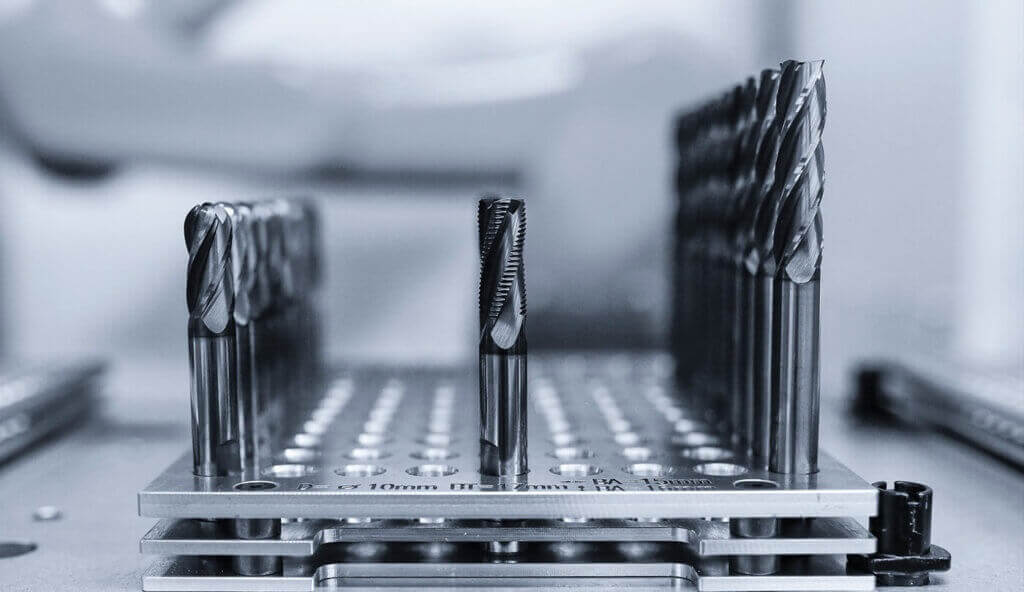
Not original, but optimal for your process
A manufacturer’s tool is developed in its original state for the widest possible range of applications. This makes sense, as it has to work in a wide variety of machines, materials and production environments. But this is precisely where the difference between “original” and “optimal” lies.
When we regrind a tool, we don’t ask the question “What did it look like in the catalog?“, but rather:
“What does it need to look like for your specific process?“
Particularly in the current tool market, which is characterized by rising raw material prices and volatile carbide prices, simply restoring the tool to its original state is often no longer sufficient. Profitability today is achieved through process optimization.
In practice, this means
- Adaptation of the cutting edge geometry to the material actually being processed
- Optimization of chip spaces for better removal
- Selection of a coating that precisely matches your application
- Fine-tuning of the cutting edge preparation to extend service life
A carbide tool can therefore be specifically improved after regrinding.
In many cases we achieve this:
- Longer service life
- more stable processes
- Lower tool costs per component
Application technology is the key: Oliver Wolf on site
Optimally regrinding a manufacturer’s tool starts with a conversation. Because every production process is as individual as every carbide tool. Cutting values, machine rigidity, materials, cooling lubrication strategy. All of this influences how a tool actually performs. And that is the reason why we focus on personal exchange when regrinding.
This is where our application engineer Oliver Wolf comes into play.
As a specialist in application technology, he knows both the theory behind regrinding and, above all, the practice on the store floor. He analyzes directly on site how your manufacturer’s tools are used, where there is potential for optimization and which adjustments make economic sense.
Together with you, he defines:
- the right geometry for your application,
- the optimum coating,
- and clear standards for future regrinding.

The decisive factor here is that we systematically store the information from this conversation, both digitally in our system and directly in the programs of our machines. In this way, we ensure that every manufacturer’s tool is machined exactly according to your defined parameters for every subsequent regrinding.
The result is a structured regrinding concept with repeat accuracy. And this is a decisive factor in today’s tool market: processes that work. Predictability that remains. And tools that are strategically developed further.
Systematic regrinding: workshops for your employees
Regrinding a single manufacturer’s tool is good. A structured regrinding process is better.
What we often experience in the tool market: Tools are given for regrinding when they are “really finished”. Without clear labeling. Without defined standards. Without transparency about service life or life cycles. Especially with rising raw material prices and permanently high carbide prices, this quickly becomes expensive.
That is why we support our customers both operationally with regrinding and strategically with setting up a functioning system.
What does this include in detail?
We help with this,
- define clear regrinding cycles
- Cleanly label tools
- Make the life cycles of solid carbide tools transparent
- structure internal processes
- Control tool stocks economically
In our regrinding workshops, we show your employees how to classify a carbide tool appropriately, when it is worth regrinding and when it is not.
The goal is always the same: to measurably reduce tool costs per component.
If you have your regrinding under control, you reduce costs and gain security at the same time. And security is a real competitive advantage in times of volatile raw material prices.
Which tools is this suitable for?
As a general rule, we regrind almost all standard solid carbide milling and drilling tools, regardless of whether they are from premium suppliers or alternative brands.
Typical examples:
- Solid carbide end mill
- Micro milling cutter
- HPC and HSC milling cutters
- Solid carbide drill bit
- Special tools made from carbide
Regrinding carbide tools is particularly economical. The material value is high, carbide prices have recently risen massively and any unused tool life potential costs money.
Simply replacing a manufacturer’s tool, even though it can technically be reconditioned several times, is usually no longer a sensible decision under current conditions.
We significantly extend the service life through professional regrinding. At the same time, we adapt the geometry and coating to the actual application. This means
- Lower tool costs per component
- Less capital tied up in the warehouse
- Less dependence on fluctuating raw material prices
- Sustainable use of existing resources
And this is precisely where the strategic advantage lies: instead of relying exclusively on new tools, the existing manufacturer tool becomes a controllable production factor.
Conclusion: Not just reground, but optimized
The tool market has changed noticeably. Rising raw material prices, persistently high carbide prices and increasing cost pressure are forcing many companies to rethink their approach. Simply replacing a manufacturer’s tool after its first service life is often no longer the most economical solution under these conditions.
It can be crucial to adapt the tool optimally to your own production process. This is where we come in with our manufacturer-independent regrinding service. Targeted geometry adjustments, the right coating and personal advice from our application engineer Oliver Wolf make this a predictable, calculable production factor that can be used economically several times over.
A professionally reconditioned carbide tool extends its service life and reduces dependency on fluctuating raw material prices and a tight tool market. Instead of reacting in the short term, you gain long-term stability and transparency in your tool strategy.
Not simply reground, but rather thoughtfully optimized.
Let us check together which manufacturer’s tools still have untapped potential in your company.
Our team and Oliver Wolf are looking forward to a personal exchange.